
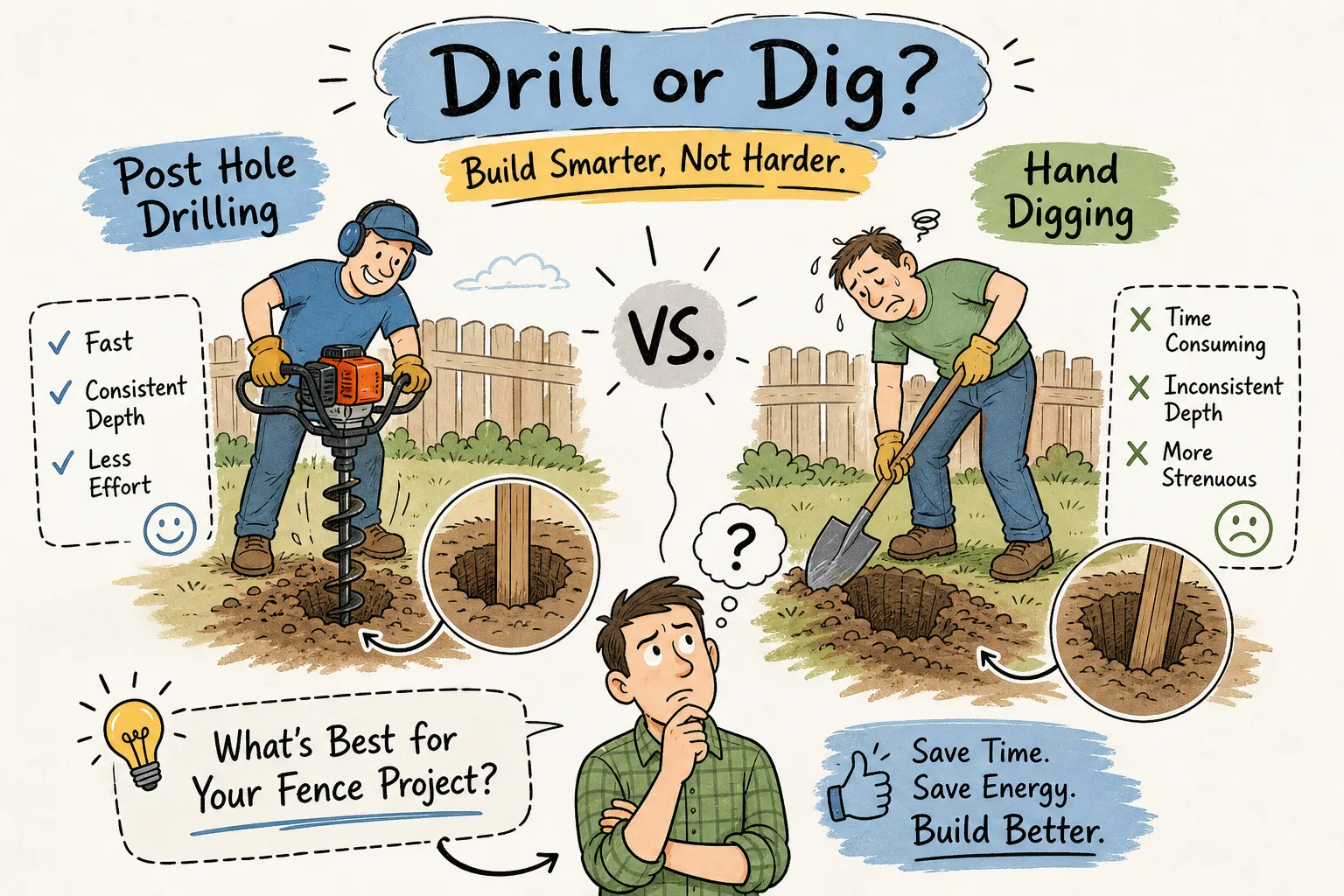
Many homeowners plan to dig the holes themselves. And honestly, if you need one or two posts in soft, sandy soil, that’s a reasonable call. But the moment a project scales up, that assumption starts costing you weekends. When you’re weighing whether to hire a post hole digging service or go the DIY route, the honest answer depends on your soil, your project size, and your timeline, not on which method sounds simpler. Fence Post Pro has been providing post hole drilling and fence installation across the Greater Montreal Area for years, and we’ve watched both approaches play out on hundreds of jobs. Here’s a straight look at when to grab a shovel and when to call someone with a motorized auger.
The question isn’t which method sounds easier. It’s which one actually fits your project, your soil, and your timeline. That’s what this article will help you figure out.
When Hand Digging Actually Makes Sense (and When It Stops Working)
Hand digging is not a bad method, it’s just a limited one. A clamshell digger or a manual post hole digger works fine for one or two isolated posts in loose or sandy soil, installations up to 24, 36 inches deep depending on soil conditions, or tight corners where a machine simply cannot fit. For small, simple jobs, it’s a legitimate option that can save you a minimum service charge from a contractor. Where it falls apart is everywhere else. Clay soil, compacted fill, rocky ground, and frozen subsoil all turn a manageable task into a brutal one.
Holes dug by hand tend to be uneven in diameter and inconsistent in depth. That inconsistency matters: based on standard contractor practice, posts set in irregular holes are more vulnerable to shifting after the concrete sets, and a fence that was plumb on day one can start leaning by spring. When you’re looking at 15, 20, or 30 holes for a full fence run, hand digging isn’t just slower. For most homeowners, it’s simply not a realistic option. That’s the point where a professional post hole digging service with the right equipment changes the entire project.
Why Powered Auger Drilling Wins on Most Residential Jobs
The equipment difference is not subtle. A one-person handheld gas auger handles light fencing in soft soil, typically up to 36 inches deep. A two-person gas auger covers standard residential fence runs with more torque and reach. A hydraulic auger mounted on a mini-excavator handles the serious work: large gate posts, deck footings, compacted clay, and rocky ground. Each tool has its range, and matching the equipment to the soil is what separates a clean job from a frustrating one. If you’re evaluating any post hole digging service, equipment capacity is the first thing to ask about, specifically whether the contractor can scale up to a hydraulic unit when soil conditions demand it.
In terms of output, a professional crew using motorized augers can drill 20 to 30 standard holes in a single day under normal soil conditions. Hand digging that same job could take several weekends. Fence Post Pro typically runs motorized augers and mini-excavators matched to the job conditions, which is what that level of daily output requires.
Powered drilling also produces something hand digging can’t: consistency. Clean, uniform holes with consistent diameter and depth make alignment straightforward on a fence run or deck perimeter. According to standard construction practice, concrete consolidates more reliably in a smooth, uniformly shaped hole than in a rough, irregular pit, which is why contractor guidance generally favors drilled holes for structural footings. Gate posts, corner posts, and deck footings often require 10 to 12 inch diameters at 48 to 60 inches deep. A small handheld auger or a hole boring service without the right torque rating will frequently hit its limits before reaching those specs.
What the Professional Post Hole Digging Service Process Looks Like
Before any drilling begins, utility locating is required. In Quebec, contacting Info-Excavation before any excavation is a legal requirement, not a suggestion. You submit a request at least three business days before digging starts, Info-Excavation notifies the relevant utility members, and they mark underground gas lines, electrical cables, water mains, and telecom infrastructure before the crew arrives. The locate is free and it protects everyone on site.
One thing worth knowing upfront: the public locate only covers utilities registered with Info-Excavation. Private lines on your property, including irrigation systems, invisible pet fencing, and backyard electrical runs, are not covered. Those need to be identified separately before anyone breaks ground. Fence Post Pro coordinates Info-Excavation locates as a standard part of the pre-job process and will walk you through what private lines need to be accounted for before the crew arrives.
Drilling, Setting, and Concrete: What Happens on the Day
Once the site is cleared and marked, the crew drills hole locations based on the layout plan to the required depth. In the Montreal area, frost depth requirements typically push holes to 48 to 60 inches, with 1.4 to 1.5 metres commonly referenced as a local planning benchmark. Concrete goes in immediately after drilling while the hole walls are clean and intact. Posts are set plumb and leveled before the concrete cures. That final leveling step is what distinguishes a full post setting service from a crew that just digs and moves on. Spoil from the excavation is either piled neatly on site or removed, depending on what the quote includes.
What These Jobs Actually Cost in the Greater Montreal Area
Post-Hole Prices: Montreal Ranges by Hole Type
For standard fence post holes in the 8 to 10 inch diameter range at 48 to 60 inches deep, budget roughly C$50 to C$100 per hole for a dig-only service in the Montreal market. At the 8 to 10 inch range with concrete, dig-and-set typically runs C$90 to C$175 per hole. Moving up to deck footings and sonotubes in the 12 to 16 inch range, prices generally land at C$150 to C$350 per hole depending on diameter, depth, and whether helical screw piles are used. Pergola and arbour footings fall in a similar range, roughly C$120 to C$300 per hole.
Most contractors also carry a minimum service charge. In the Montreal area, that typically runs C$350 to C$700 for small jobs. If you’re only having three or four holes drilled, the minimum charge often sets the floor on what you’ll pay, regardless of the per-hole rate, worth factoring in before you call around for quotes.
What drives the price up? Depth, hole diameter, soil conditions, and site access are the main variables. Clay, rocky ground, and old fill all add time. Getting a machine into a narrow backyard may require hand-carrying equipment or switching to a smaller unit. Concrete, debris haul-away, and post setting are often listed as separate line items, so get clarity on what’s included before accepting any number. A post hole digging service that bundles utility locating, on-site concrete, and leveling into the quote is worth more than a dig-only price, even when the total looks higher on paper. Fence Post Pro provides on-site quotes because soil conditions and access vary too much from one yard to the next for accurate numbers over the phone.
Safety and Permit Considerations You Can’t Skip
Under Quebec law, any excavation requires a locate request through Info-Excavation at least three business days before digging begins. This applies equally to homeowners and contractors. Striking a buried utility line creates serious physical danger and significant legal and financial liability. The locate is free. There’s no good reason to skip it. As noted above, the public locate does not cover private service lines on your property, irrigation systems, invisible fencing, private electrical runs, and septic-related infrastructure remain your responsibility to identify before anyone digs.
On the permit side, many municipalities in the Greater Montreal Area require a permit for new fence installations over a certain height. Deck footings and structural additions almost always require one. The rules vary by borough, and what applies in one area of the city may not apply in the next. Checking with your local municipality before work starts is non-negotiable. Contractors with extensive experience in the local market are generally more familiar with borough-specific bylaws, which reduces the risk of building something that has to come down and be rebuilt to meet code.
What It Looks Like to Hire Fence Post Pro for Your Project
Many homeowners assume a post hole digging service will only drill the holes and leave, but full set-and-level packages are common, and Fence Post Pro handles the complete process in a single visit: utility locates, motorized auger or mini-excavator drilling, on-site concrete pouring, and post leveling. That means you’re not coordinating multiple trades or managing a concrete delivery on your own. You come back to a yard with clean, set, level posts ready for the next phase of construction.
The company serves homeowners building DIY fences, contractors who need a reliable subcontracting partner for drilling, and anyone dealing with deck footings, pergola anchors, shed bases, or pool enclosures across the Greater Montreal Area. Here’s what some of those jobs look like in practice:
- A 40-post privacy fence run through a clay backyard, completed in a single day with a hydraulic auger unit and a two-person crew
- Deck footings for a 500 square foot extension drilled and poured in a half-day under normal soil conditions
- A pool enclosure with 20 posts set plumb and concrete-poured within a standard workday
Results like these depend on crew size, equipment match, hole depth, and soil conditions, they’re not guaranteed on every job, but they reflect what proper equipment and local site knowledge make possible.
Soil conditions, frost depth requirements, permit norms, and site access patterns vary significantly across the Montreal area. That local context is built into every job Fence Post Pro does. If you’re planning a fence, deck, or pergola project in Greater Montreal, getting an on-site quote before you start is the right move. Fence Post Pro offers on-site quotes across the Greater Montreal Area, contact the team to schedule a site visit.
The Bottom Line
Hand digging has its place. For a single post in workable soil, it’s a legitimate choice. For most residential fence and footing jobs, it’s slower, harder on your body, and produces less consistent results than a properly equipped post hole digging service. Many homeowners find that once a project hits five or six holes, or when minimum service charges are factored in, hiring a professional delivers better value than the DIY alternative.
You now have what you need to make a clear decision: when to call a professional post hole digging service, what the process actually involves, what it costs in the Montreal market, and what to verify before hiring anyone. Ask for proof of utility locating, get clarity on what’s included in the quote, and confirm that whoever shows up has the right equipment for your soil type. Get the holes done right the first time, and the rest of the project builds on a solid foundation.

