
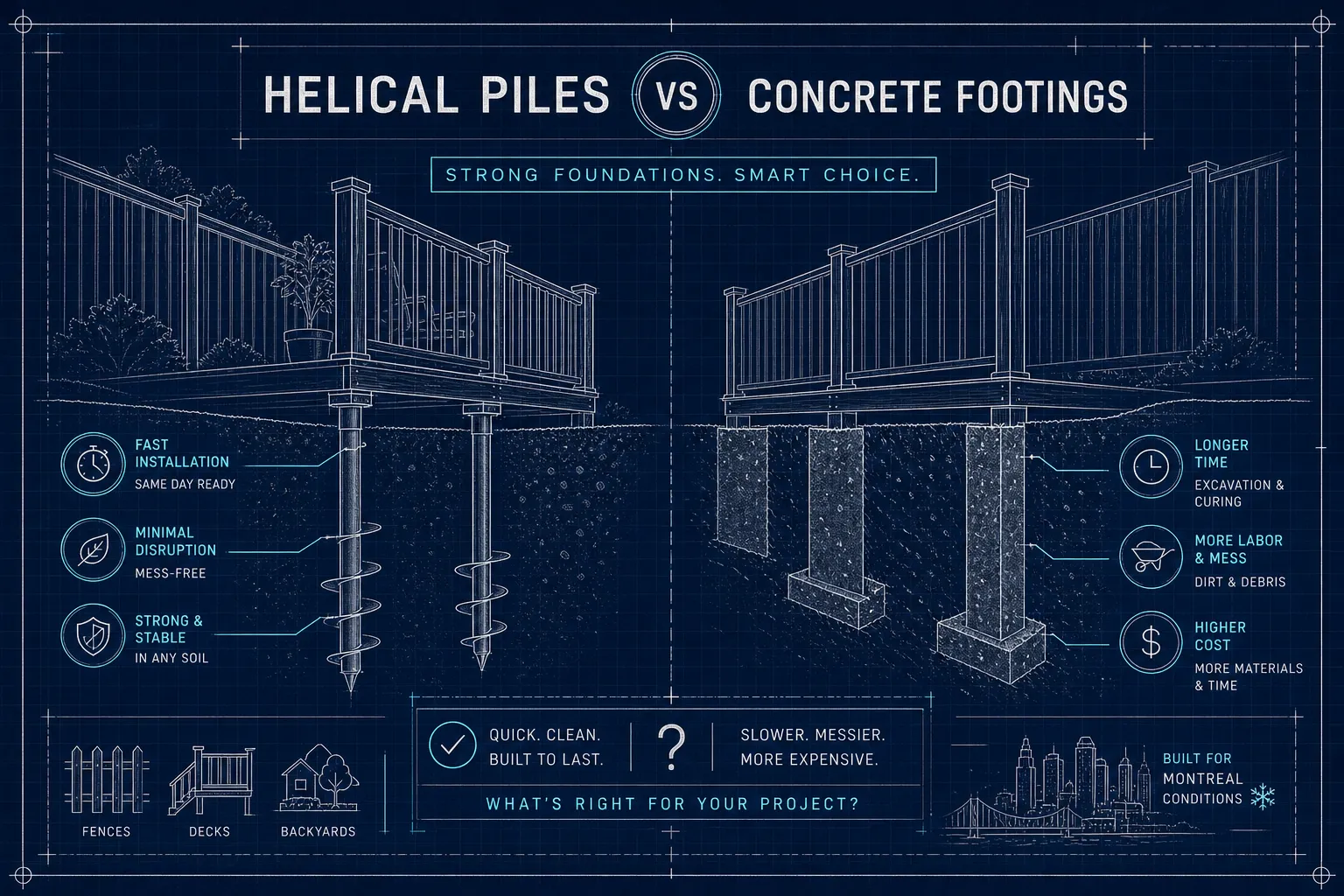
Choosing between helical piles vs concrete footings for your Montreal fence or deck is one of the most consequential calls you’ll make before a single piece of framing goes up. A fence post that heaves out of the ground every spring, or a deck footing that cracks after a few freeze-thaw cycles, isn’t a minor inconvenience. It’s money you spend twice. Soil conditions, site access, project load, and Quebec code all push the answer in different directions.
The team at Fence Post Pro has spent years drilling footings and setting screw piles across the Greater Montreal Area, and they report seeing both methods work beautifully and both fail badly. This article breaks down what actually separates the two, what they cost in 2026, when each one makes sense, and what needs to happen before any digging starts on a Montreal property.
How each foundation handles Montreal’s freeze-thaw reality
Montreal experiences frequent freeze-thaw action throughout the winter and shoulder seasons, and the frost line in this region commonly reaches 1.2 to 1.5 metres depending on site conditions and municipal requirements. That depth requirement effectively rules out shallow, unprotected footings for typical residential projects unless a code-compliant frost-protection strategy is in place, and it shapes every foundation decision that follows. Confirm the specific frost-depth requirement with your borough before finalizing any design.
Frost heave and why it’s a particular concern in Greater Montreal
Frost heave is a mechanical problem. Saturated fine-grained soils, which dominate much of greater Montreal, expand vertically as they freeze. A concrete footing that doesn’t reach below the frost line will move every winter, sometimes dramatically. Helical piles bear on a deep helix plate well below the active frost zone, so the structure stays put even as the upper ground shifts seasonally. This is a particular concern in parts of Greater Montreal where Champlain Sea clays and high water tables are present, conditions that amplify frost-heave risk compared to many other Canadian regions.
There is one detail worth knowing about steel piles in frost-susceptible soil: adfreeze. When the pile shaft sits in frozen ground without appropriate detailing, the frozen soil can grip it and pull upward. Proper pile design addresses this through accepted strategies such as protective sleeves or thermal breaks that limit the bond between the shaft and the frost-active layer. A qualified installer treats this as a standard engineering requirement, not an afterthought.
What each method can realistically carry
A basic concrete footing on competent soil, say, a 2-foot by 2-foot pad, carries roughly 8 kips of allowable load. A common 2.875-inch round-shaft helical pile delivers around 50 kips allowable. For a fence or a light deck, both methods work. For a larger deck addition or a pergola with concentrated point loads, that gap starts to matter. Concrete footings scale by size; helical piles scale by shaft diameter and helix configuration. Neither is inherently stronger across every application, but helical systems reach deeper bearing layers without requiring full excavation.
How Montreal’s clay soils change the picture
Many parts of the island and the South Shore sit on dense till or, in some areas, sensitive marine clay, sometimes called Leda clay. This material can lose structural integrity when disturbed. A wide excavation for a concrete footing can disturb the surrounding soil and create settlement problems that show up years later. A helical pile installs with minimal disturbance, which is a significant practical advantage on those sites. In Laval and the flatter South Shore communities, thick Champlain Sea clay is common enough that it needs to be planned for, not discovered mid-project.
Helical piles vs concrete: real installation timelines and 2026 costs in Montreal
Most contractor websites hide behind vague ranges. The numbers for a Montreal residential project in 2026 are more specific than most contractors advertise.
What a helical pile installation day looks like
The sequence is straightforward: submit the Info-Excavation locate request, mark the layout, mobilize the equipment (a small hydraulic machine or a mini-excavator), advance each pile to target depth and minimum torque, then attach the bracket or cap. A standard residential deck with six to eight piles is often done in a single day. No curing time means framing can start the same afternoon or the following morning.
For tight backyards common in Montreal suburbs, compact mini-excavators can pass through many narrow residential gates that a standard concrete truck cannot, exact clearance varies by machine model, so confirm equipment dimensions with your contractor before booking.
Concrete footing timeline and the cure delay most people underestimate
The concrete footing process has more steps: excavate to below frost depth, set the sonotube form, pour the concrete, then wait. That wait is the variable most homeowners underestimate. Concrete reaches enough strength for light loading around seven days and full design strength at 28 days. In a Montreal October or early April, cold temperatures slow that hydration further. Factor in the inspection required before pouring, and the total elapsed time from first dig to framing often runs two to three weeks. That’s not a flaw in the method; it’s the reality of how concrete works.
Helical piles vs concrete footings: a side-by-side cost breakdown for Montreal in 2026
Helical piles installed in the Greater Montreal Area run roughly C$400 to C$600 per pile for straightforward residential work. A six-pile deck foundation lands at approximately C$2,400 to C$3,600 for the piles alone, before deck framing begins. Concrete sonotube footings come in at roughly C$200 to C$300 per footing installed. On a pure per-unit basis, concrete costs less. But mobilization, spoil removal, longer project timelines, and the risk of frost movement on marginal soil narrow that gap considerably. Add engineering, permits, and difficult access, and both methods end up in overlapping cost territory on larger projects.
Soil and site conditions that tip the decision
The right foundation method isn’t decided by what looks simpler on paper. It’s decided by what’s under the property.
Dense till, clay, and the fill sites common around Montreal
Much of the suburban Montreal ring sits on varying combinations of dense till, stiff clay, and disturbed fill from previous construction. Fill sites are problematic for concrete footings because compressibility varies unpredictably across a lot. A helical pile, sometimes called a helical pier or helical anchor depending on the application, advances through the fill and bears on undisturbed material below. Stiff to hard clay is actually excellent bearing material for a helical system. Loose, saturated silt is trouble for both methods, but a helical pile can be advanced deeper to reach something competent. A concrete footing poured into saturated silt is a different matter entirely.
Restricted yards, fenced lots, and previously drilled sites
Many Montreal residential lots are narrow, already fenced, or bordered by structures on multiple sides. A sonotube pour requires a clear path for a concrete mixer, or at minimum the ability to manually mix and carry material in buckets. Helical pile equipment is compact. For a property replacing an old fence along a lot line with no vehicle access, screw pile installation with a walk-behind or mini unit is often the only practical option.
Previously drilled sites add another layer: helical piles can be installed adjacent to an existing hole without disturbing it. Excavating for concrete next to an old footing risks undermining what’s already holding. This is a pile vs footing comparison that comes up regularly on Montreal infill and renovation jobs.
Quebec code, permits, and the utility locate requirement
Quebec has specific legal requirements that apply before any ground penetration. Most homeowners and some contractors don’t know the full picture until something goes wrong.
What Quebec requires before the first drill goes in
Quebec law requires property owners and contractors to submit an Info-Excavation locate request at least four business days before any ground penetration. This applies equally to helical pile installation and post hole drilling. It is not optional, and it is not just a best practice. Fence Post Pro states that as a registered Info-Excavation partner, the locate process is handled before any equipment touches the ground on every job. Skipping this step risks hitting buried gas, telecom, or electrical lines, not a risk worth taking to save a day on the schedule.
Permit and engineering expectations for each foundation type
Concrete footings for qualifying residential structures in Quebec can sometimes follow prescriptive code tables for sizing and frost depth. Helical piles are a different story. As a proprietary engineered foundation system, also referred to as helical piers or helical anchors in engineering documentation, they generally require a CCMC evaluation number, a qualified installer with documented credentials, and in many cases a sealed structural design. A licensed engineer specifies the pile diameter, helix configuration, required installation torque, and frost-heave detailing. Municipalities across the Greater Montreal Area do require engineering documentation before issuing permits for deck additions or structural fence foundations. Confirm requirements with your borough office before assuming either method proceeds without drawings.
When screw piles win and when concrete still makes sense
Both methods can produce a solid, frost-resistant foundation when installed correctly and to the right depth. The question is which one fits the actual site in front of you.
The conditions that favour helical piles
In a direct helical piles vs concrete comparison, screw piles are the stronger choice in these situations:
- Poor near-surface soil: soft clay, loose fill, organic material, or saturated silt
- Restricted access where excavation equipment can’t reach the work zone
- A tight schedule where a concrete cure delay is unacceptable
- Saturated ground where an open excavation would fill with water
- Previously disturbed sites where adjacent footings could be undermined
In Montreal, tight urban lots and South Shore clay properties come up repeatedly in these situations. A fence along a five-foot side yard with no vehicle access is a classic helical pile job. Fence Post Pro reports handling many such projects, including properties in Laval where old concrete footings had heaved and screw piles were installed beside them without disturbing what was already in place.
When poured concrete footings remain the practical answer
Concrete is the right call when dense, stable, well-drained soil exists at frost depth and the project carries heavy permanent loads that benefit from a wide bearing pad. It also makes sense when the site has good access and the schedule has room for cure time. Split those conditions into a checklist: good soil, open access, no time pressure. If all three apply, concrete often wins on cost.
Concrete is also frequently the right answer when boulders or very dense gravel make helical pile advancement impossible. For a standard backyard fence in a well-drained Montreal suburb with sandy loam soil and open yard access, a properly poured concrete post is entirely appropriate and costs less. The goal is the right method for the site, not a default preference for one over the other.
Moving forward with your Montreal fence or deck project
Fence Post Pro installs both Pylex helical screw piles and poured concrete footings across the Greater Montreal Area, including on the island, Laval, Longueuil, and the West Island communities. For helical piles, the crew advances piles to the required torque and depth, installs the bracket or post cap, and leaves the site ready for framing the same day. For concrete footings, the team drills to below frost depth, sets sonotubes, pours and levels the concrete, and returns once curing confirms the footing is ready to build on. Every job starts with an Info-Excavation locate request, without exception.
Getting a quote starts with a site visit. A phone description of a backyard can’t tell you whether the soil is fill over clay, whether site access suits the required equipment, or whether a neighboring footing might be affected by excavation. Those things become clear when someone looks at the ground. Book an on-site assessment with Fence Post Pro, and the team will confirm which foundation method fits the project, the soil, and the budget. Reach out by phone or through the website to schedule a visit.
The helical piles vs concrete decision in Montreal ultimately comes down to soil conditions, site access, and schedule. The freeze-thaw cycles here don’t care which method you chose, they care about depth, bearing capacity, and whether anyone confirmed what’s underground before digging started. The answer is almost never obvious from a blueprint. It becomes clear when someone looks at the ground.

